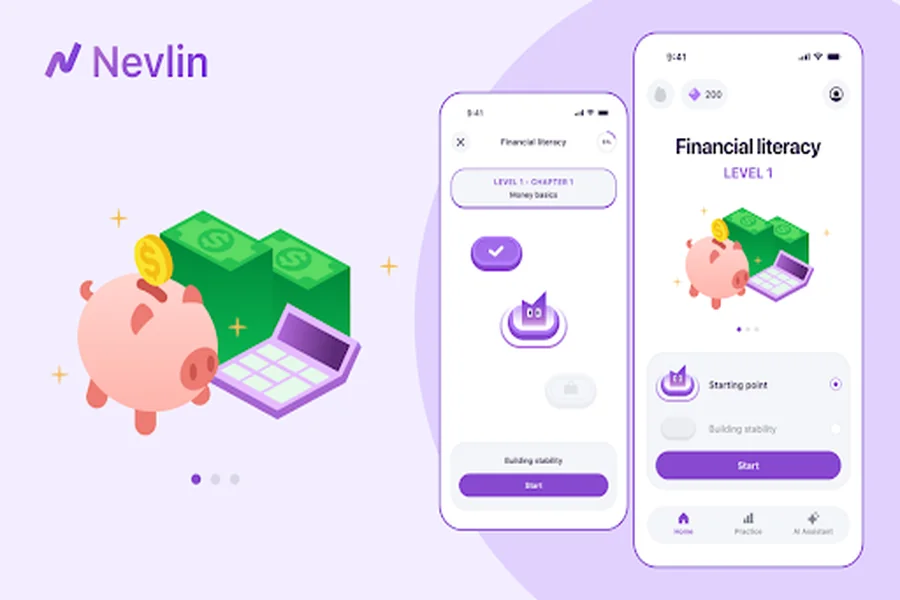
Nevlin organizes financial education into a learning experience you can follow one chapter at a time. The app gives money topics a clear structure, combining short lessons with questions, explanations and practice.
You can explore Personal Finance, Investing and Trading according to what interests you. Within that range, the course structure provides direction, making individual lessons part of a wider journey through the subject.
This combination of choice and structure is one of the app’s appealing qualities. You have room to explore different topics while keeping a clear focus on the lesson you are working through now.
1. Choose the subject that interests you
Nevlin offers three areas of learning. Personal Finance introduces everyday money skills; Investing explores concepts around investments and markets; Trading introduces further market topics, including price movements and risk.
You can take courses in the order that suits your interests and switch between them. That flexibility gives the learning experience room to grow with your curiosity, whether you want to concentrate on everyday money or explore the market material too.
2. Follow the structure within your learning
The Nevlin learning paths provide a sequence of short chapters. Each chapter gives you a manageable part of the subject to explore, with the course connecting individual ideas over time.
A defined sequence makes the next step easier to identify. You can devote the session to understanding the current concept, knowing that it belongs within a broader body of material you can continue to work through.
3. Begin with the explanation in front of you
Nevlin uses plain language to make concepts approachable. A chapter introduces the idea and places it within a recognizable context, giving you a starting point for the questions and examples that accompany the learning.
This is particularly useful when a topic contains unfamiliar vocabulary. The explanation gives the words a role, so you can understand what they contribute to the subject instead of encountering them as disconnected definitions.
4. Engage with questions as you progress
Questions invite you to take part in the chapter. You consider a situation, make a choice and then read the explanation behind the answer. Each activity connects the material with a specific piece of reasoning.
This adds variety to the learning path. A concept can appear first in a description, then in a question that brings an important distinction into focus. The sequence develops through these different ways of engaging with an idea.
5. Explore connections with the AI Assistant
The optional AI Assistant can help explain how an idea from one chapter relates to the next. It also offers plain-language explanations of terms and quiz answers, giving you a place to ask your own questions along the way.
For instance, a familiar concept may appear inside a new topic. Asking how the two connect helps you place the new material within what you have already studied, keeping the path coherent as your vocabulary grows.
6. Put market concepts into simulated practice
Nevlin’s simulated-money exercises let you work with historical market scenarios. You can make a choice, see what happened next and try another approach, adding an interactive dimension to the course material.
That experience gives later explanations something concrete to connect with. A scenario you have explored can become a useful reference point when a related concept appears again in a chapter or question.
7. Continue from the progress you have made
Completed modules mark your progress through the learning sequence. Nevlin saves that progress between sessions, so you can return to the course and continue when you have time for another lesson.
Over time, the chapters form a connected learning routine. Familiar ideas return, new topics add context and your interests can guide which course you explore next. The structure keeps those separate sessions part of an ongoing experience.
Nevlin combines a clear course sequence with the freedom to explore different money subjects. Choose a topic, work through a chapter and follow the next step, building your understanding through lessons that connect.